Vultr pricing: what still costs money after stopping or destroying a server?
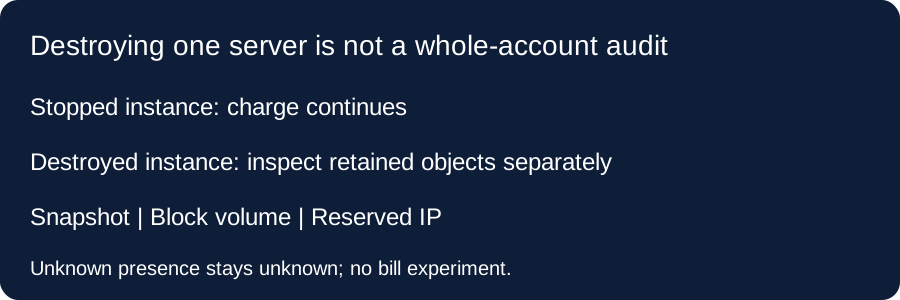
Stopping a Vultr server does not stop its instance charges. Destroying it ends that instance charge, but a snapshot you keep has a separate storage charge. Check independently retained volumes and reserved IPs as separate items before concluding that your account has no continuing costs. This page audits the boundary between those items; it does not inspect your account or provide a current checkout total.
Reproducible audit inputs
All four rows below are synthetic software fixtures, not customer accounts or observed bills.
| Case | Instance | Snapshot | Volume | Reserved IP | Result |
|---|---|---|---|---|---|
| A | stopped | absent | absent | absent | instance |
| B | destroyed | present | absent | absent | snapshot |
| C | destroyed | absent | present | unknown | block_volume, reserved_ip_presence_unknown |
| D | destroyed | absent | absent | absent | clear within listed scope |
Download the inputs, results and evidence hashes and the runnable checker.
Does a stopped Vultr instance still cost money?
Yes. The official stopped-instance billing documentation says charges continue while the server remains allocated. Turning it off is not a billing exit. Destroying that instance is a separate action; review retained objects and preserve any data you need before acting. Our lifecycle checker models those separate inventory fields, without accessing your account.
The documented boundary
Vultr documents hourly server billing from deployment and continued charges while stopped. Its snapshot page separately prices stored snapshots at USD 0.05 per GB per month. Its Block Storage deletion guide says deleting the volume stops further charges and removes its data. Those statements identify different resource lifecycles. They do not establish that destroying a server automatically removes every other resource in an account.
Audit case A: the server is stopped
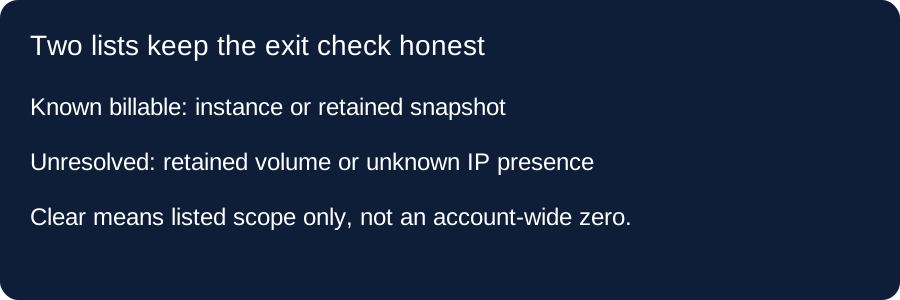
We supplied our checker with instance=stopped, snapshot=false, volume=false and ip=false. The result contains instance in the known-billable list, has an empty unresolved list, and does not mark the exit clear. Changing only the power state therefore does not complete our documented exit check. The false values are explicit fixture inputs, not observations of a customer account. This case tests whether a reassuring stopped label can incorrectly override the server billing rule.
Audit case B: destruction with a saved snapshot
Our second fixture changes instance to destroyed and snapshot to true; volume and ip remain false. The instance category disappears from the result, but snapshot remains known billable. The exit is still not clear. This comparison isolates one retained object rather than claiming an entire bill vanished. Snapshot size is deliberately absent from the fixture, so the checker reports a category without inventing a monetary amount. The published storage unit price alone cannot fill in that missing size.
Audit case C: a volume remains and the IP is unknown
The third fixture has instance=destroyed, snapshot=false, volume=true and ip=unknown. Its unresolved list contains block_volume and reserved_ip_presence_unknown. We did not give either item a made-up price or infer that it was automatically released. A retained volume needs its own documented deletion and charge check. The IP cell needs an account inventory and applicable terms before it can become present or absent. This case tests the important failure mode where an empty compute list is mistaken for a complete inventory.
Audit case D: clear within the listed scope
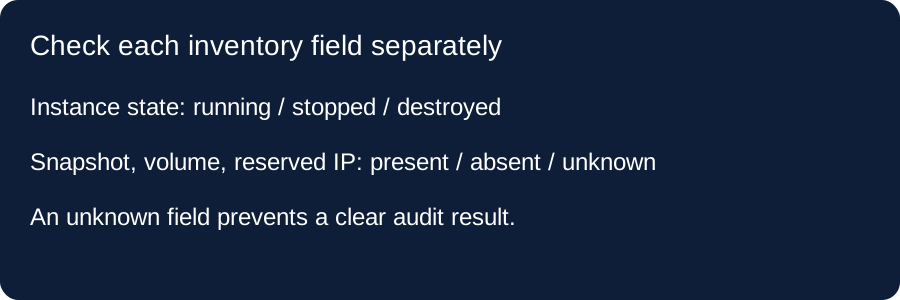
The fourth fixture sets instance=destroyed and all three retained-resource flags to false. Both output lists are empty, so our checker marks only the listed scope clear. That result is narrower than an account-wide zero-cost claim: other services, accrued charges, taxes or resources outside this register have not been inspected. We also tested an unknown snapshot flag separately; it stays unresolved and prevents a clear result. An unsupported instance state is rejected rather than treated as destruction. Download the fixtures to reproduce these checks.
Use our four-field exit register
Our register separates instance state, retained snapshot presence, retained block-volume presence and reserved-IP presence. Each retained-resource cell accepts present, absent or unknown. This design makes the inventory explicit: an unfilled cell cannot silently mean absent. Our two result lists distinguish documented continuing categories from unresolved checks, so a missing price is not the same as a zero price. Copy this structure for the resources you actually have, add the relevant resource identifiers privately, and verify deletion status before changing a cell. This article has not deleted any resource or accessed a billing console.
Why can a charge appear after a server is destroyed?
A remaining invoice does not by itself establish new post-destruction instance usage. Vultr says monthly invoices reflect accrued charges from the previous billing period. Review the service, usage period and independently retained objects before interpreting the total. No real invoice was tested here.
What remains unknown
This audit does not establish account-specific tax, credits, monetary charges for reserved IPs or volumes, automatic release behavior, or a current server quote. Removing resources can delete data; preserve anything you need before acting. The checker is an original, reproducible documentation model, not a live billing tool.
Official sources
Retrieved October 8, 2026. Original audit and synthetic fixtures; no purchased server, account inventory or observed invoice.