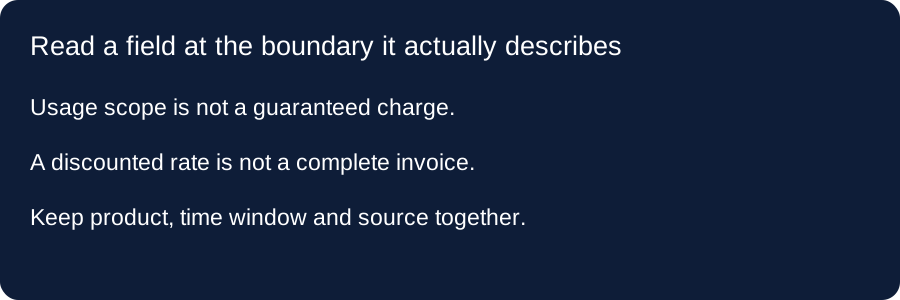
VPS server transfer allowance: which traffic actually counts?
A VPS server transfer allowance is meaningful only after checking which traffic the provider meters. In the DigitalOcean Droplet example, public outbound traffic counts toward the team pool, inbound traffic is free, and private VPC traffic follows a different route. IPv6 uses the public interface. Counted transfer is not automatically an extra charge: the applicable allowance still matters. This page maps routing evidence; it does not inspect your traffic or calculate your bill.
The scope of the official rule
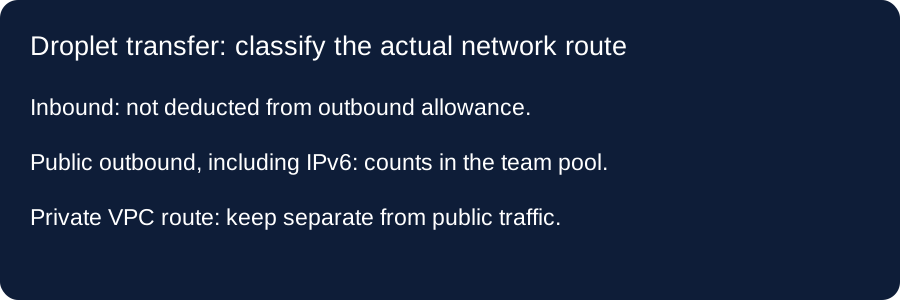
DigitalOcean documents a team-level Droplet transfer pool. Public-interface outbound traffic contributes to it; IPv6 uses that interface. Transfers between Droplets using VPC networking use a private interface. Its documentation also excludes outbound transfer it determines was dropped by a DigitalOcean firewall rule. These are Droplet-specific accounting rules, not universal promises about every VPS or every firewall. Keep the product and network path attached to the evidence.
Our original route register
We built a register with product, direction, network route, IP version and provider-confirmed firewall-drop evidence. It deliberately does not store an advertised bandwidth speed as a transfer allowance. A product boundary is checked before the routing rules, so an object-storage record cannot silently inherit the Droplet classification. Missing direction or route produces an unresolved label rather than a free label. This makes the register suitable for checking an explanation against its documented scope, without inventing account usage.
Reproduce the routing cases
All rows are synthetic test inputs, not measured packets, purchased servers or customer invoices.
| Case | Direction | Route | IP version | Classification |
|---|---|---|---|---|
| A | inbound | public | 4 | inbound_not_counted |
| B | outbound | public | 4 | counts_team_pool |
| C | outbound | vpc_private | 4 | vpc_private_not_counted |
| D | outbound | unknown | 6 | counts_team_pool |
| E | outbound | public | 4 | provider_dropped_not_counted |
| F | outbound | unknown | unknown | unresolved_route |
| G | outbound | vpc_private | 6 | inconsistent_route_evidence |
Download inputs and official capture hashes · Download the runnable checker
Cases A and B: the same interface, opposite directions
We supplied two public IPv4 fixtures and changed only direction. Case A is inbound and returns inbound not counted. Case B is outbound and returns counts team pool. This paired test isolates the direction field: a public address alone cannot explain which side of the allowance a transfer belongs to. Neither fixture includes a byte quantity or a team allowance. Consequently, the result identifies an accounting category while leaving monetary cost uncomputed. That is narrower than claiming the transfer caused a bill.
Case C: private VPC traffic needs a route field
Our third fixture is outbound IPv4 over a private VPC route. Its result is VPC private not counted. The input is an explicit synthetic route, not a conclusion drawn from the destination being another server. A nearby destination or shared provider name cannot fill this field in an actual inventory. Compare this case with public outbound case B to see why a route must remain visible beside direction. We have not configured a VPC or tested packet delivery.
Cases D and G: IPv6 and contradictory evidence
Case D supplies outbound IPv6 and leaves the route cell unknown. The documented IPv6 public-interface rule makes this case count toward the team pool. Case G instead supplies IPv6 together with a private VPC label; our checker marks that combination inconsistent rather than selecting whichever value looks cheaper. This is a consistency test of our model, not a network diagnosis. The conflicting record must be resolved before using it in a transfer comparison. No IPv6 connection was generated for this audit.
Case E: keep the firewall exception narrowly labelled
This public outbound fixture sets provider firewall drop evidence true and receives provider dropped not counted. The flag represents DigitalOcean-determined drops in the synthetic case. It does not represent a local application refusing a connection or a user guessing that a packet disappeared. Our register therefore records the authority behind the exception instead of treating every failure as excluded traffic. Removing the flag returns the normal public outbound classification. The test does not claim access to a provider firewall log.
Case F: unknown routes do not become free transfer
The final unresolved fixture supplies outbound direction while leaving route and IP version unknown. The result remains unresolved route. We also tested a missing direction and obtained unresolved direction, and a Spaces product input produced outside scope. An invalid direction is rejected. These tests protect three separate boundaries: incomplete evidence, a different service and malformed inputs. None can quietly become a zero-cost route. Add actual routing evidence privately before replacing an unresolved cell; the checker has no account connection.
Does traffic that counts toward the pool always cost extra?
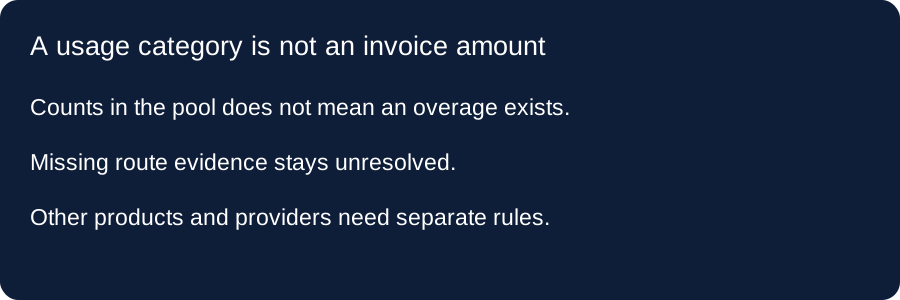
No. A counted category contributes usage to the applicable allowance; it is not proof of an overage. The actual allowance and usage must be known before discussing an extra transfer charge. This route classifier intentionally produces no monetary estimate. A large network-speed number is also a different field from a quantity of included transfer.
What remains unmeasured
This is a documentation-derived model for DigitalOcean Droplets only. No traffic was generated, no VPS was rented and no account invoice was read. It does not calculate accrued allowances, predict monthly usage or substitute another provider's policies. Documentation can change; preserve the applicable product and evidence date when checking a quote.
Official evidence
Captured October 10, 2026; original routing register and synthetic fixtures.
DigitalOcean bandwidth billing: Droplet direction, route and pool rules