VPS Prices With IPv6: Separate Free Support From Address Charges
IPv6 does not have one universal VPS price. Compare the exact address product: DigitalOcean documents standard Droplet IPv6 at no additional cost, while its Reserved IPv6 addresses are also free when unassigned; Hetzner says Primary IPv6s are free and generally absent from invoices. Vultr’s setup guide explains when its public IPv6 is assigned but does not state a price. Do not turn an address-count label into a price assumption.
Official documentation checked November 10, 2026. This is a documentation review, not a purchase, account quote, network test, or invoice audit.
What the official pages say about IPv6 cost
| Provider and address type | Documented price statement | Assignment or billing scope | Official source checked |
|---|---|---|---|
| DigitalOcean standard Droplet IPv6 | IPv6 support is available at no additional cost. | Enabling IPv6 gives a Droplet 16 additional IPv6 addresses; the documentation says IPv6 is available in every region. This describes standard Droplet IPv6 support, not every separate networking product. | IPv6 Details — generated November 9, 2026; read November 10, 2026 |
| DigitalOcean Reserved IPv6 | Reserved IPv6 addresses are free even when not assigned to a Droplet. | The same page says all Reserved IPs are free when assigned. Transfer from Reserved IP and BYOIP addresses remains subject to standard Droplet bandwidth billing. | Reserved IPs Pricing — last verified October 26, 2026; read November 10, 2026 |
| Hetzner Cloud Primary IPv6 | Primary IPv6s are free and generally are not listed on invoices. | Hetzner describes Primary IPs and Cloud servers as separate resources. It says a Primary IP must be deleted to stop paying where a charge applies; the FAQ explicitly identifies Primary IPv6 as free. The FAQ last changed July 7, 2020, so check the live project terms before relying on it. | Cloud Billing FAQ — page last changed July 7, 2020; read November 10, 2026 |
| Vultr Cloud Compute IPv6 | The cited setup guide does not publish a price. | Vultr says a public IPv6 address is assigned only when IPv6 is enabled during instance configuration. This is an assignment rule, not evidence that the feature is free or paid. | Add IPv6 to a Cloud Compute Instance — updated November 4, 2026; read November 10, 2026 |
These rows keep separate products separate: standard IPv6 on an instance, a Reserved IPv6, a Primary IPv6 resource, and an IPv6 setup instruction. Only the cited source’s stated pricing is shown. The Vultr documentation reviewed here does not establish an IPv6 fee, so this page leaves that amount unstated.
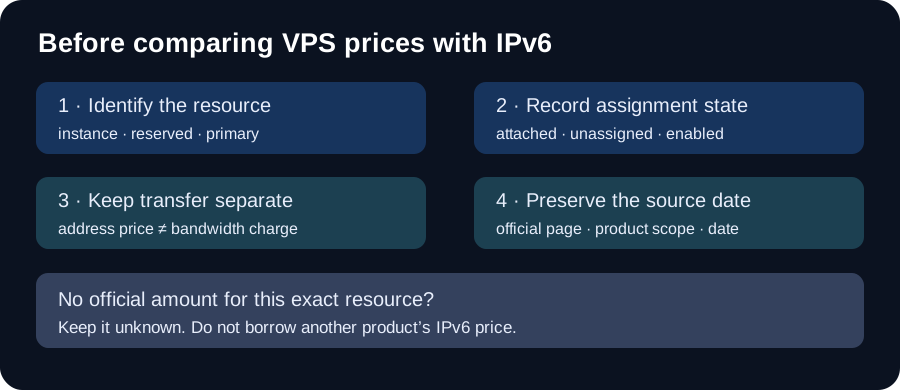
Our original IPv6 cost worksheet
A plan label such as “IPv6 included” does not by itself answer what an architecture will cost. We use a five-cell record for each address line, and leave a cell unknown when the provider’s cited document does not answer it:
- Resource: record standard instance IPv6, Reserved IPv6, Primary IPv6, or another named product. Do not combine rows just because each uses IPv6.
- Assignment state: note whether the resource is attached, unassigned, or enabled only during instance setup.
- Address quantity: copy the provider’s documented count or allocation rule. Do not assume that a subnet size means every address is separately billable.
- Transfer rule: record whether traffic is covered by a bandwidth allowance or billed under a separate rule. A free address does not imply free data transfer.
- Evidence date and uncertainty: save the official source and the date read. Mark the price unknown if the source describes setup but publishes no amount.
For a chosen setup, use documented monthly total = compute line items + documented address line items + applicable transfer charges + applicable tax. Add an IPv6 address amount only when the official source identifies a charge for that exact resource and state. If it does not, keep the cell as “not stated in cited source” instead of substituting a number from another product or an older page.
One subtle but useful distinction is the difference between price and assignment. DigitalOcean documents 16 additional addresses after IPv6 is enabled, while its Reserved IPv6 pricing page separately says reserved IPv6 remains free even when unassigned. That second fact answers a lifecycle question that an instance address count alone cannot answer. Neither statement should be generalized to another provider.
Reading address labels in a VPS comparison
In the retained VPS Price Tracker benchmark capture, plan labels include both “IPv4 + IPv6” and “IPv6 Only.” Those labels are useful for identifying the advertised network configuration, but a label alone does not tell a reader whether the IPv6 resource is standard, reserved, separately invoiced, free while unassigned, or subject to a transfer rule. This guide adds a source-linked billing and assignment layer to that label check. The benchmark note is one retained competitor sample; it is not a claim about every result or every competitor page.
When comparing two plans, first match the service role: public inbound service, outbound-only job, or private-network workload. Then record the provider’s exact address type and whether it requires an explicit enable step. Finally, follow the source for the charge lifecycle and data transfer. If a provider source states the address is free but separately refers transfer to bandwidth billing, preserve both statements rather than calling the whole network path free.
Does a VPS price always charge extra for IPv6?
No universal rule follows from these sources. DigitalOcean documents standard Droplet IPv6 at no additional cost; Hetzner’s FAQ says Primary IPv6s are free; Vultr’s cited setup page explains assignment but does not state a price. Use the provider and product-specific source.
Is an unassigned IPv6 address always free?
No. DigitalOcean’s Reserved IPv6 pricing page explicitly says reserved IPv6 is free when unassigned. Hetzner’s FAQ says its Primary IPv6s are free. Those are provider-specific statements, not a general rule for every address product.
Does free IPv6 mean IPv6 data transfer is free?
Not necessarily. DigitalOcean’s Reserved IP pricing page says transfer from Reserved IP and BYOIP addresses is subject to standard Droplet bandwidth billing. Check the cited transfer policy separately from the address price.
Official evidence and limits
- DigitalOcean IPv6 Details — address count, no-additional-cost statement, and availability.
- DigitalOcean Reserved IPs Pricing — assigned and unassigned Reserved IPv6 pricing and transfer billing.
- Hetzner Cloud Billing FAQ — Primary IP separation and Primary IPv6 billing statement.
- Vultr IPv6 setup guide — when public IPv6 is assigned; no price asserted here.
Reviewed November 10, 2026. One cited FAQ is dated 2020; its age is stated above. No instances were purchased or configured, no packets were sent, and no customer billing accounts or invoices were accessed. Prices and product rules can change; confirm the provider’s current quote and terms before ordering.
See our provider comparison or return to the VPS Price Watch home page.