VPS Prices With IPv4: Check the Address Line Item
To compare VPS prices fairly, add the public IPv4 cost required for your setup to the compute price. Providers do not treat every address the same: DigitalOcean bills IPv4 separately on supported v5 Droplets and currently lists an introductory $0.00 line item; Hetzner documents Primary IPs as separate billable resources; Vultr Reserved IPs cost $0.004 per hour ($3 per month). These are different product and address types, so compare the exact quote and lifecycle rule rather than copying one provider’s IP price onto another.
Official sources checked November 10, 2026. This is a documentation review, not a purchase, account quote, or invoice test.
What the official pages actually bill
| Provider and product | Address cost evidence | Scope to preserve | Official source checked |
|---|---|---|---|
| DigitalOcean v5 Droplets | Public IPv4 is a separate invoice line. The documented introductory line-item price is $0.00 and may change under the terms. | This statement is for v5 configurations; do not assume it describes every bundled Droplet. The create flow lets users clear both public IP options for a Private Droplet. | Droplet pricing and Create a Droplet — November 10, 2026 |
| Hetzner Cloud Primary IPs | The billing FAQ describes a Primary IPv4 as a separate resource billed separately from the Cloud Server. | Hetzner says a server can exist without a public IP and its total is lower without a Primary IPv4. Check the current project quote for the amount; this page does not reuse an older posted rate. | Cloud billing FAQ and Primary IP overview — November 10, 2026 |
| Vultr Reserved IP | The official support article lists $0.004 per hour ($3 per month). | This is the Reserved IP product, not a claim that every instance’s primary address is billed this way. A deleted Reserved IP remains counted against quota for 24 hours. | Are Reserved IPs Free? — November 10, 2026 |
The line items are not interchangeable. DigitalOcean’s cited $0.00 is explicitly introductory and applies to v5 Droplets; Hetzner’s cited material establishes separate resource billing but we leave the current amount blank; Vultr’s number is for a Reserved IP. Keep those labels attached to every comparison.
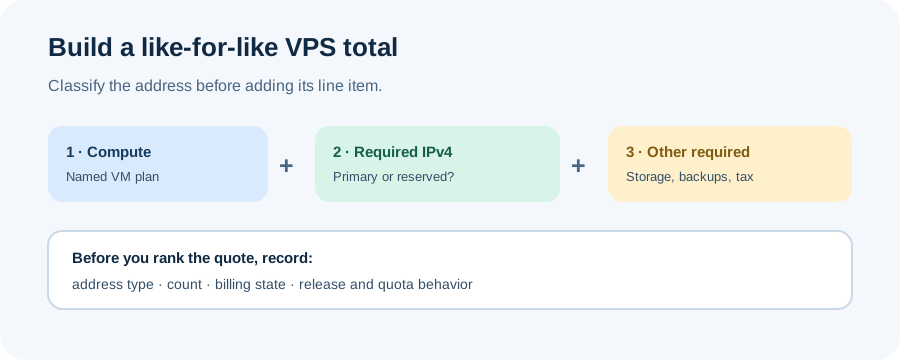
Our original IPv4 quote worksheet
A low VPS price can be a correct compute price and still be the wrong total for a public-facing service. We use a five-field worksheet so the address does not disappear inside an unlabeled “monthly” figure:
- Product: record the named VM family or configuration, not just the provider.
- Address type: mark primary public IPv4, reserved/static IPv4, private IPv4, or IPv6. A Reserved IP is not automatically the VM’s primary address.
- Required quantity: count the public addresses the architecture needs. Do not multiply by optional addresses that are not in use.
- Billing state: note whether the price is bundled, a separate invoice row, introductory, or conditional on attachment.
- Release behavior: record when billing ends and whether deletion still affects a quota or reassignment window.
For a monthly comparison, our calculation is required setup total = compute charge + required public IPv4 charge + other required resources + applicable tax. For two identical public-facing nodes, the address term is 2 × the per-node required IPv4 charge. This is arithmetic for the chosen design, not a provider quote. Keep optional reserved addresses in a separate column so they do not inflate a basic one-server estimate.
We also separate money from availability. Vultr’s 24-hour quota hold after deleting a Reserved IP is not an extra 24-hour charge stated by that source; it is a reuse constraint. Conversely, a zero introductory line item at DigitalOcean does not mean the line item is permanently free. The worksheet stores both fields so readers do not convert one into the other.
How to use the comparison before checkout
First decide whether the workload needs a public address at all. DigitalOcean’s official creation instructions say a Private Droplet has neither public IPv4 nor public IPv6 selected and is reachable only through another resource with public access in the same VPC, such as a bastion host or load balancer. That changes the network design, not just the displayed price. Do not select “private” in a spreadsheet if the application still needs direct public ingress.
Next, compare the same address requirement across quotes. If one plan bundles a primary IPv4 and another shows it separately, add the required line item to the latter before ranking totals. If the source calls the value introductory or says it can change, preserve that qualification beside the number. If the source does not expose a current amount, leave the amount unknown and verify it in the provider’s live quote; do not fill the blank with a third-party estimate.
Finally, check the lifecycle after shutdown or deletion. The price calculator should model the resource that is actually billable, while a separate operations note should capture address retention, quota, and reassignment limits. This prevents a common comparison error: treating “server deleted” and “address immediately reusable” as the same event.
Does a VPS monthly price always include IPv4?
No. The cited official documents show different models, including a separate billable Primary IP, a separately listed introductory line item, and a paid Reserved IP. Check the exact product and address type on the provider’s own quote.
Can I compare the Vultr Reserved IP rate with a Hetzner Primary IPv4 rate?
Only after confirming both addresses satisfy the same role in your design. The cited Vultr rate is for its Reserved IP; the Hetzner documentation describes Primary IP resources. Their labels, attachment rules, and lifecycle behavior differ.
Is DigitalOcean’s $0.00 IPv4 line permanent?
The pricing documentation calls it an introductory line-item price and says it may change under the Terms of Service. Treat it as the value documented on the review date, not a permanent guarantee.
Official evidence and limits
- DigitalOcean Droplet Pricing, including v5 IPv4 line-item scope.
- DigitalOcean: How to Create a Droplet, public/private address selection.
- Hetzner Cloud Billing FAQ, separate Primary IP resource accounting.
- Hetzner Primary IP Overview, address types and limits.
- Vultr: Are Reserved IPs Free?, rate, product scope, and quota hold.
Sources reviewed November 10, 2026. Prices and terms may change. We did not provision instances, attach or delete addresses, access customer accounts, or inspect invoices.
See our provider comparison or return to the VPS Price Watch home page.