Best VPS server: compare CPU allocation before counting cores
The best VPS server depends on the workload and the access its quote actually includes. Start by separating shared from dedicated CPU allocation; identical vCPU counts do not establish identical sustained throughput. DigitalOcean documents these as different access arrangements. Our original comparison register keeps allocation, region, family and generation visible, and leaves missing fields unknown. It checks labels, not performance, and produces no provider ranking.
What the documented CPU labels mean
DigitalOcean describes dedicated CPU Droplets as having guaranteed access to a full hyper-thread. A shared CPU Droplet may share that thread with other Droplets, so full access is not guaranteed. Those provider-specific descriptions establish an allocation distinction. They do not supply a measured speed ratio between arbitrary plans. Keep the plan family and applicable generation alongside a vCPU count rather than borrowing a definition from a different provider.
Our original quote-field register
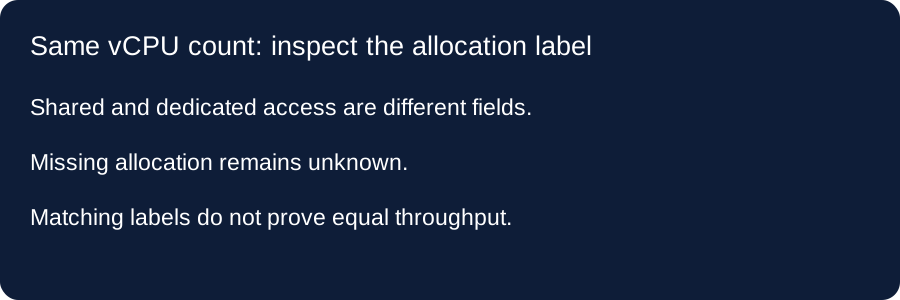
We created seven required columns: provider, product, region, plan family, vCPU count, allocation and generation. The comparison checks which columns are missing before marking differences between known values. It never fills a blank allocation cell from a low price or a premium marketing word. All records in our test suite use fictional provider and family names so that no row looks like a purchasable offer. The register is a way to preserve scope when reading a quote, not a shopping score or a CPU benchmark.
Six reproducible synthetic comparisons
All names, counts and changed values in this table are invented test inputs. They are not official plan specifications or measured server results. The left reference has two vCPUs and a shared allocation label.
| Case | Changed right-record fields | Result |
|---|---|---|
| A | allocation: dedicated | different quote fields |
| B | allocation: None | unknown fields |
| C | none | matching labels, performance untested |
| D | vcpu_count: 4 | different quote fields |
| E | generation: None | unknown fields |
| F | provider: other-synthetic-provider, region: other-test-region | different quote fields |
Download all records, formulas and capture hashes · Run the original comparison checker
Case A: isolate allocation while keeping the count fixed
The reference and comparison both have two fictional vCPUs. We change only the allocation label from shared to dedicated, leaving provider, region, family and generation unchanged. The checker returns a difference in allocation. That result does not assign a numerical performance improvement or declare the dedicated-labelled record best. It merely shows why a count-only comparison would discard an input that the quote register treats as material. A swapped-record test finds the same changed field, so the result does not depend on which row was presented first.
Case B: an omitted field cannot become a cheap equivalent
Our next record keeps the same count but replaces allocation with an unknown value. The checker lists allocation as missing. It does not infer shared allocation from cost, and it does not assume dedicated allocation because a plan name sounds premium. The fixture contains no price at all. This intentional omission is useful when checking whether a comparison table has enough evidence to compare entitlements. Restore the documented allocation field before treating the row as matched; do not generate a convenient value to complete the table.
Case C: matching all labels still leaves performance untested
For the third pair we change nothing. Every required label matches, and the checker returns matching labels, performance untested. This result is deliberately narrower than same speed or best value. No latency, throughput, CPU model sample, host contention or workload measurement is present in either record. Matching published fields can be a prerequisite for a fair comparison without being its final result. Our fixture protects that boundary by requiring the untested qualifier even when the register has no missing cells or differences.
Cases D and E: more units and an unknown generation
Case D changes the fictional count from two to four while preserving allocation. The output records a count difference and stops short of promising double throughput. Case E leaves the count at two but removes generation; the output is an unknown field. In our method a larger count and a missing generation are different evidence problems, so they cannot be summarized by one winner badge. We have not divided a price by either count, estimated a workload result or assumed a hardware generation from a provider name.
Case F and the malformed-input controls
The final pair changes both fictional provider and region. The checker reports those two scope differences while leaving the equal CPU fields intact. We also supplied zero, a negative value, a boolean and a fractional CPU count; each was rejected by our positive-integer fixture model. This input rule describes the synthetic register, not every possible cloud configuration sold by a provider. It prevents our own test rows from quietly becoming a comparison of invalid values. No server was provisioned, and no external account was queried.

Does dedicated CPU automatically identify the best VPS server?
No. An allocation label describes an access arrangement; it cannot settle your workload requirements, the rest of the quote or measured performance. The official plan guide discusses workload fit. This page therefore gives a comparison method rather than claiming a universal winner.
What remains unmeasured
This documentation-based register does not contain current offer prices, purchased servers or benchmark results. It does not rank providers or predict workload capacity. The fictional records explain how our field checks work; they do not describe actual DigitalOcean plans. Other providers require their own applicable definitions and source evidence.
Official evidence and test provenance
Captured October 13, 2026. All comparison records are project-authored synthetic fixtures.