Azure virtual server pricing: retail rates are not your account bill
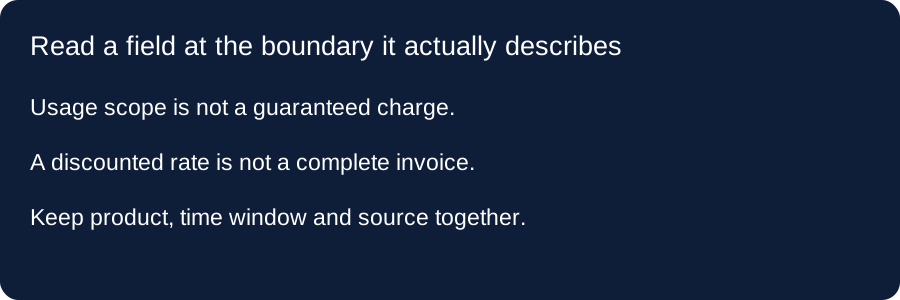
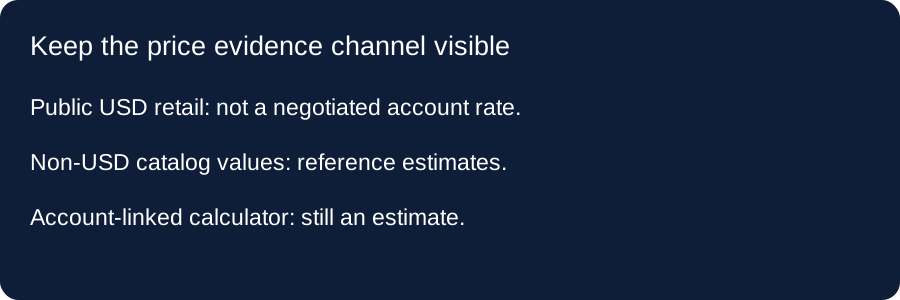
Azure virtual server pricing depends on the evidence channel as well as the selected service. Public Retail Prices data provides retail rates; it does not establish your negotiated account price or actual charge. Microsoft labels non-USD catalog prices as reference values for estimates. A calculator can use selected agreement pricing, but its output remains an estimate. Our original source register makes these boundaries explicit without accessing any account or inventing a discount.
What the official pricing documents establish
Microsoft describes Retail Prices as an unauthenticated retail-rate source. Its property table labels retailPrice as retail pricing without a discount and unitPrice as the same value. It treats non-USD values as references for estimates. The calculator documentation explains retail estimates and how selected billing accounts, profiles or agreements can supply negotiated pricing. Neither a public rate nor a calculator estimate is presented here as a private invoice.
Our original source-first register
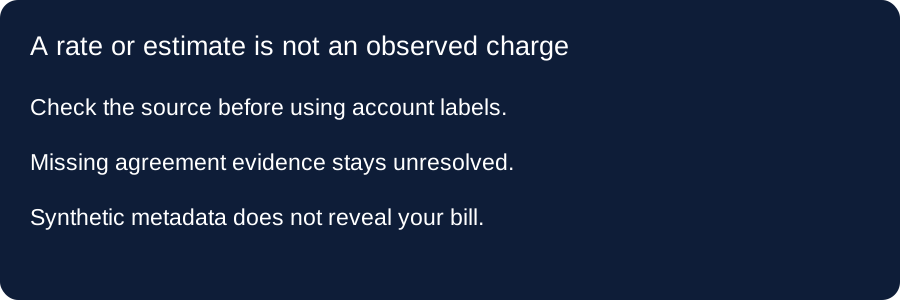
We place the evidence source ahead of any account label. The register holds currency, whether an agreement is linked, whether the account matches and whether a required profile is selected. These are explicit synthetic metadata fields, not details extracted from your browser. A source category cannot be changed simply by adding an account-looking annotation. The register does not store a quoted amount, so it cannot output an invented discount or a supposed invoice total. Its only output is the supported interpretation of the supplied evidence fields.
Six reproducible evidence cases
All inputs below are project-selected synthetic metadata, not real sessions, prices or billing profiles.
| Case | Evidence description | Register output |
|---|---|---|
| A | {'source': 'retail_catalog', 'currency': 'USD'} | public USD retail rate |
| B | {'source': 'retail_catalog', 'currency': 'EUR'} | non-USD reference rate |
| C | {'source': 'calculator', 'agreement_linked': False} | retail estimate, not invoice |
| D | {'source': 'calculator', 'agreement_linked': None} | unresolved agreement scope |
| E | {'source': 'calculator', 'agreement_linked': True, 'account_matches': True, 'profile_selected': True} | agreement-linked estimate, not invoice |
| F | {'source': 'calculator', 'agreement_linked': True, 'account_matches': False, 'profile_selected': True} | different account scope |
Download inputs, classification rule and source hashes · Run the original checker
Cases A and B: currency does not add account evidence
Our first pair uses the same public-catalog source and changes only a currency code, from USD to EUR. Case A returns public USD retail rate; case B returns non-USD reference rate. Both remain public evidence. The currency change cannot supply an agreement, selected account or paid transaction. We also remove the currency in a separate test, which produces an unresolved currency result. No exchange rate or converted amount is calculated. This pair tests the boundaries of a label rather than the cost of any Azure VM.
Cases C and D: unknown is different from explicitly retail
Case C represents a synthetic calculator record whose agreement flag is explicitly false. Its output is retail estimate, not invoice. Case D leaves that flag unknown, and the result stays unresolved agreement scope. These are different records even though neither includes account pricing evidence. Our method preserves the difference between a verified absence of a linked agreement and information that was never checked. A screenshot of a large total cannot fill this missing flag. The test does not read a live calculator or infer a contract from a login avatar.
Case E: a linked agreement still does not create a bill
We next set the synthetic agreement-linked flag true, the account-match flag true and the profile-selected flag true. The output is agreement-linked estimate, not invoice. This result records the evidence chain without promoting anticipated usage into observed consumption. No private billing profile was opened, and no price sheet was downloaded for this example. The fixture is a control that protects the estimate qualifier when more account-scope evidence is present. It does not promise a discount, identify its amount or say that your account has an agreement.
Case F and the annotation control
Case F changes only the account-match flag to false while retaining the linked agreement and selected profile. The checker returns different account scope. In an additional control, we attach an agreement-looking flag to a public USD catalog record; the output remains public USD retail rate because its source has not changed. We also reject a text value in place of an explicit agreement flag and keep unsupported sources separate. These tests prevent an attractive annotation from overriding provenance. They are synthetic input checks, not observed account errors.
Do equal retailPrice and unitPrice values prove there is no account discount?
No. The public API documentation defines these public fields as equal. That equality does not inspect your private agreement. Keep public field definitions separate from the pricing evidence for the selected billing account. Our register deliberately avoids calculating a discount from public field names.
What this audit leaves unknown
This page supplies no live Azure rate, customer contract, invoice amount or actual usage. It does not query the Retail Prices API or sign in to the calculator. The classification is a partial evidence model, not a full Azure pricing or billing implementation. Service parameters and applicable account documentation still need to be established before an account-specific conclusion.
Official evidence and test provenance
Captured October 14, 2026. All case records are synthetic metadata.