Our credit-routing ledger: identify the beneficiary before the amount
We built a document ledger that joins the migration application, startup eligibility and partner-offer directory. Each record has a service receiving the benefit, an admission route, a decision event and an issuance event. This organization is our own analysis of the linked sources. It is not a submitted application, an approved account, a successfully redeemed code or a prediction of the credit a particular company will receive.
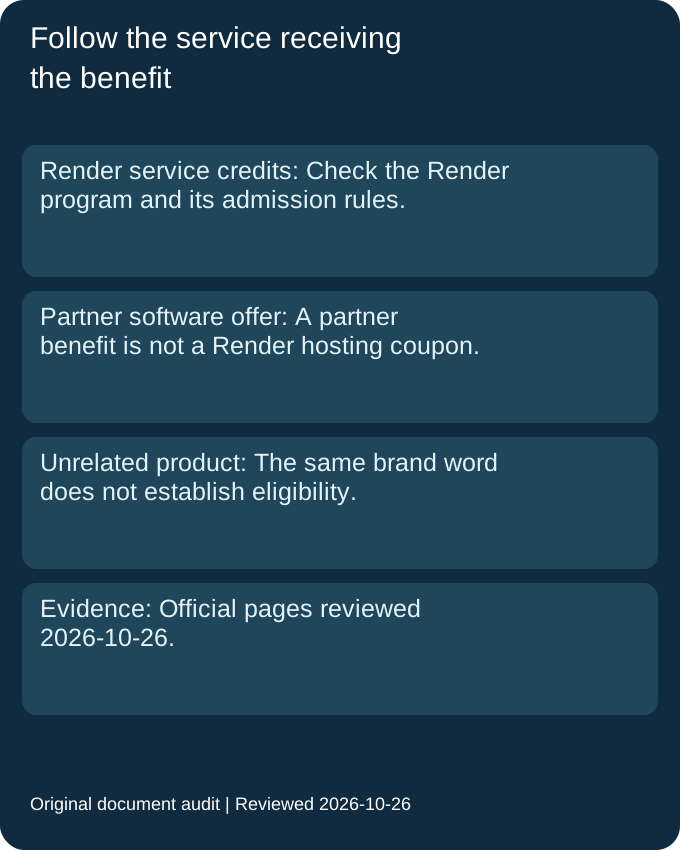
Use a beneficiary test to keep different products apart
Start with the service you intend to pay for. A partner offer displayed on the Render website can reduce a bill for that partner's software without reducing a Render hosting bill. We label such a record partner software, even when Render publishes the directory. The publishing domain establishes who described the offer; it does not change which service the benefit buys. Likewise, a promotion for another product sharing the word Render cannot be assigned to this cloud platform without a matching official statement.
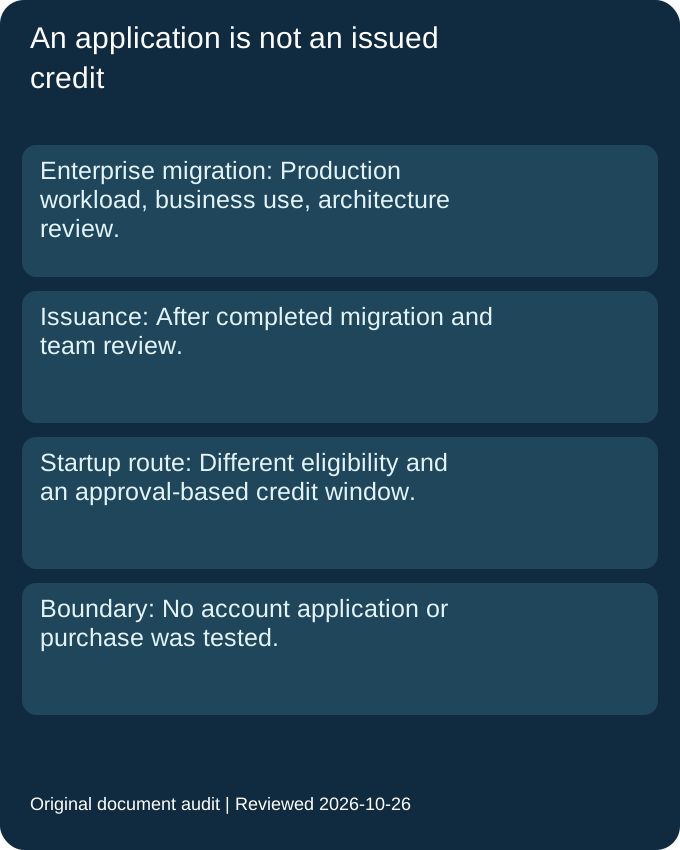
Our first synthetic case is a reader seeking hosting credit who encounters a partner-software benefit. The ledger returns a different beneficiary, not an eligible hosting discount. A second case has a production business moving infrastructure and reading the enterprise migration page. That returns the relevant application route, but still not an award. These cases use fictional reader circumstances and document classifications; they do not measure a checkout or test an account.
Keep application, review and issuance as separate states
The migration FAQ connects credit issuance to a completed migration reviewed with the team. Our ledger therefore has distinct states for an application sent, an architecture review arranged, a possible offer determined and a migration completed. A reader at the first state cannot fill the last state merely because the page advertises a maximum. This prevents an estimated promotional ceiling from becoming a fictional balance in a budget.
For a third hypothetical case, assume that an application exists but the infrastructure has not moved. The issuance field stays unconfirmed. For a fourth case, assume that migration has finished but there is no team review or individual award information. That field also stays unconfirmed. The rule is deliberately conservative: completed migration and team review are documented prerequisites, while our analysis has no authority to grant a credit or calculate its value.
Do not transfer one program's clock to another
The startup page measures its credit validity from approval. The enterprise page describes a different issuance event after migration. Our ledger stores the program beside its clock, so an approval-based startup window cannot silently become the expiry of an enterprise migration offer. Where the reviewed enterprise material does not provide a fixed public closing date, that date remains unpublished. A review timestamp records when we read the page, not when a visitor's benefit expires.
Finally, early-stage startup routing is an eligibility question, not a smaller version of the enterprise maximum. We record the startup route separately and leave its funding, customer and partner requirements attached to it. Moving a reader between routes requires checking those fields again. The completed worksheet thus answers which evidence to collect next without adding unrelated credit amounts together or promising admission to either program.