An evidence ledger for a conflicting landing page
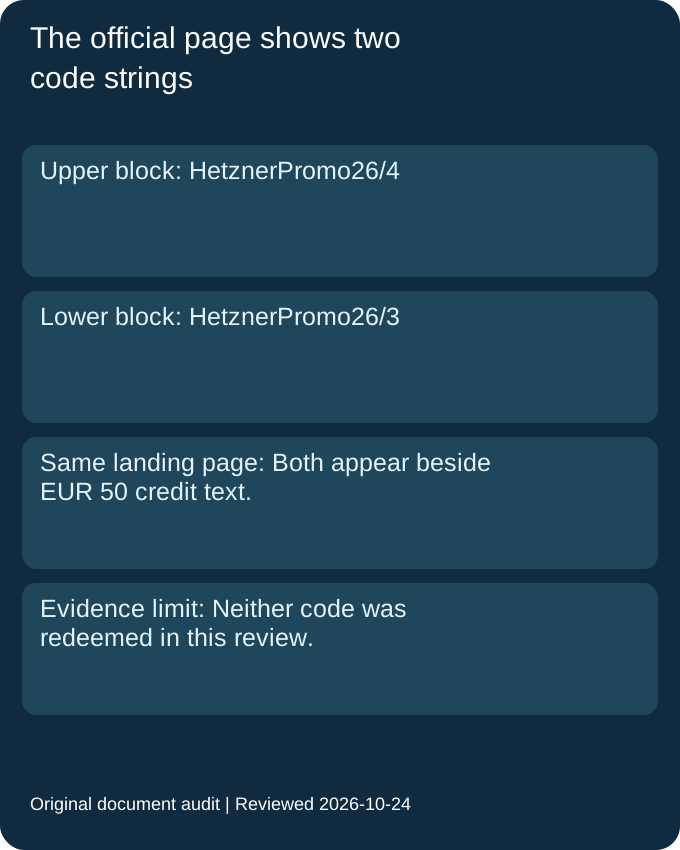
Our review separates the published benefit from the literal code observations. The landing page advertises the same introductory credit in two locations, but the upper and lower code strings have different final characters. We preserve those observations independently rather than silently correcting the lower block or announcing that one code supersedes the other. Neither conclusion follows just from the rendered page.
Record a location before treating a code as verified
The first record stores the upper block, its code ending in slash four, the official source address and our review date. The second stores the lower block and its code ending in slash three. Their shared introductory description does not prove that both codes can be redeemed, that either accepts an existing account, or that the amounts can be combined. Those are separate claims requiring separate evidence.
A reader can repeat the check by opening the official landing page and looking at both credit blocks before opening the account interface. If the page has been corrected since our observation, use its current wording and the account's displayed details. This ledger is a dated record of what we saw, not an instruction to prefer an older code. It is also not a successful redemption report: no account was created, no code was submitted and no paid resource was ordered.
Separate an account-age limit from a credit-use window
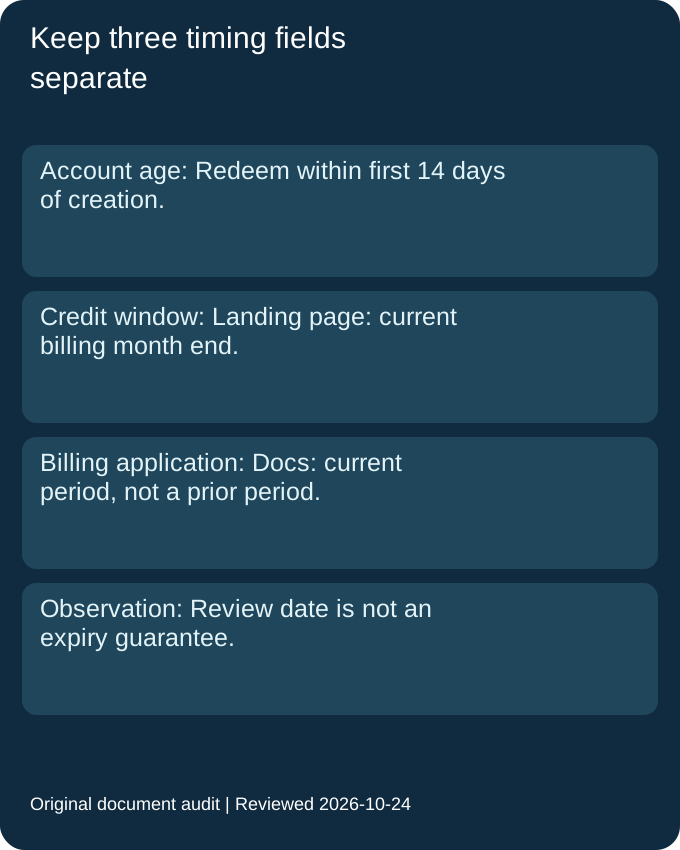
The landing page ties redemption to the first fourteen days after account creation and ties credit validity to the end of the current billing month. These are different clocks. Our worksheet records them as separate fields and refuses to replace them with a generic month of free hosting. An account-age limit tells the reader when to submit a code; it does not by itself establish how long any resulting balance lasts.
The public statement does not identify a timezone or an exact closing timestamp. We therefore do not produce a countdown or calculate a deadline for an imaginary customer. The account overview's displayed validity is the next relevant observation for an actual holder. Our review timestamp tells readers when the public statement was checked; it does not extend the provider's window or reset it when someone visits this page.
Keep code admission separate from balance ordering
The documentation restricts the combination of referral and cloud promo codes. It also describes what happens when multiple credits are active: product-specific cloud credit is used before general credit for cloud products, followed by priority based on remaining validity. Our worksheet treats those as different stages. A rule for spending existing balances is not permission to redeem a prohibited pair of codes.
This produces a reproducible check without making a purchase. First compare the literal strings and their locations. Next record the account-age and validity fields independently. Finally read admission constraints before applying the balance-order rule. A record with conflicting strings remains unresolved even if its benefit amount matches. A spending-priority statement never turns a disallowed combination into an allowed one. These are synthetic document-consistency checks, not an account balance simulation or a test of actual invoice allocation.
Which literal code is printed on the official landing page?
The reviewed upper credit block prints HetznerPromo26/4; the lower block prints HetznerPromo26/3. Both are official-page observations. We have not verified acceptance of either code.
Official source · Reviewed 2026-10-24
Does the offer promise a full month from the day I redeem?
The reviewed landing page instead says validity ends at the end of the current billing month. Keep that separate from the first-14-days redemption condition.
Official source · Reviewed 2026-10-24
Can the credit-order rule override the referral restriction?
No such permission is established. The documentation separately restricts referral versus cloud-code redemption and describes the ordering of already-active credit balances.
Official source · Reviewed 2026-10-24
Which account fields should I check?
The official guide identifies Valid until, For product, Name, Amount and remaining in the promo-code overview. Read those fields for the actual code and account.
Official source · Reviewed 2026-10-24