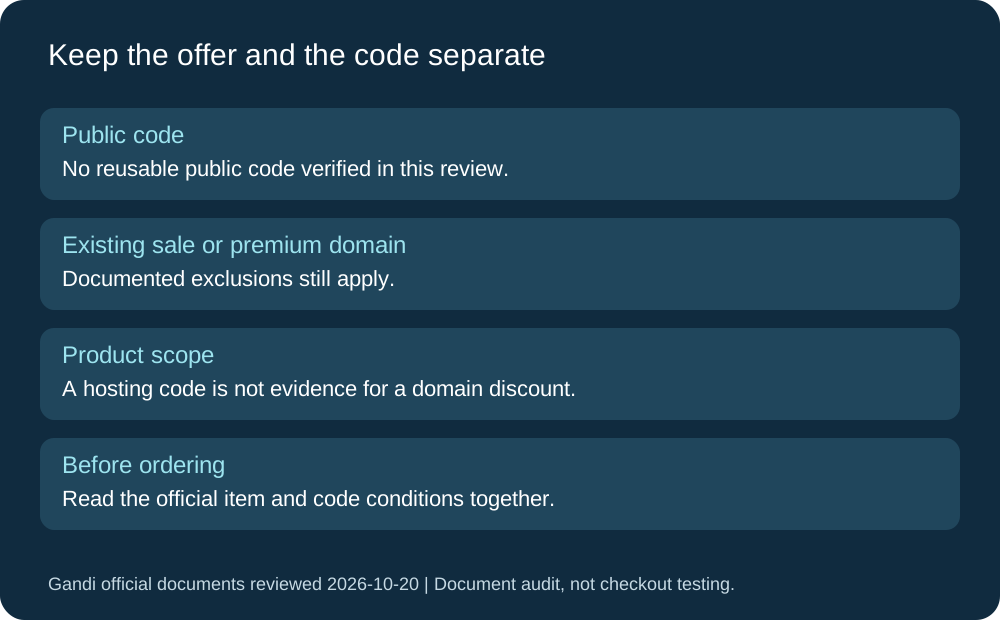
No currently reusable public code was verified on the official pages reviewed. Gandi’s official US promotion page does list domain offers, including .online registration at $1.99 for one year, and a separately scoped discount on new web hosting subscriptions. Follow the official offer rather than inventing a code.
Last checked and updated: 2026-10-20T09:10+08:00
Official promotions checked today
The domain amounts below are the current card prices in the selected USD view, excluding VAT. Original, struck-through and renewal prices are not reproduced.
Offer
Conditions and end status
Official source
Reviewed
.online registration $1.99
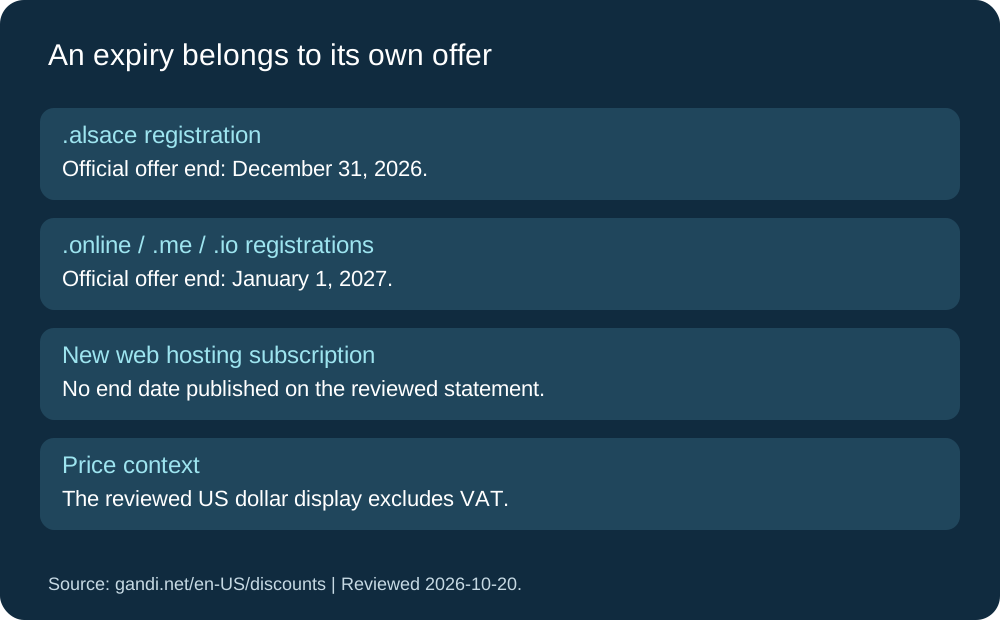
1 year; selected United States / USD / A-rate view Offer end: January 1, 2027
Official page advertises this for new web hosting subscriptions; it is not a store-wide domain coupon Offer end: not published. An unpublished end date is not a promise of permanence.
Keep the offer and the code separate. Original document-based diagram; official sources and review date are listed below.An expiry belongs to its own offer. Original document-based diagram; official sources and review date are listed below.
Check the transaction before looking for a code
We converted the official exclusions into four hypothetical cart records and checked each record against the documented conditions. These are synthetic document tests, not purchases, successful redemptions or a measurement of checkout acceptance. The result tells a reader which published restriction to investigate; it does not supply a code or establish eligibility for a particular account.
Test A: the advertised registration price plus an extra code
Take a cart record with a domain registration whose promotional price has already been selected. Mark its existing-sale field as true and leave the proposed code unused and unexpired. The existing-sale field alone is enough to trigger the documented reduced-price exclusion. A fresh code does not turn that field false. Our practical check is therefore to keep the offer-card price and the code route separate, rather than calculating an extra reduction against an amount that is already promotional.
Test B: a premium domain with a matching product code
Next use a record labelled premium, with a domain-specific code and no existing-sale flag. A product match does not clear the premium exclusion: these are independent conditions. Before comparing any displayed registration amount with a premium listing, inspect the listing type. If it is premium, the ordinary promotion table is not evidence that a code can reduce that purchase. We deliberately do not substitute a standard registration quote for that record.
Test C: an ordinary domain and a hosting-only code
The third record is not premium and is not already discounted, but its product is a domain and its code is restricted to hosting. Passing the first two checks does not make the product restriction disappear. This is why the hosting promotion has its own row, with its own scope, instead of becoming a headline discount for all purchases. A shopper should compare the product written on the code with the exact line item before relying on it.
Control record: no listed exclusion is triggered
Finally mark a hypothetical ordinary domain as not already discounted, paired with an unused, unexpired domain code. Our small checker finds no exclusion among those recorded fields. Its output is deliberately “no listed exclusion triggered”, not “valid coupon” or “order accepted”. We have neither an issued code nor account-specific order evidence. Other conditions may remain, and the provider must still determine the real order result.
Keep dates and display settings beside the amount
The offer rows also have different date fields. The .alsace card ends on December 31, 2026, while the selected .online, .me and .io cards end on January 1, 2027. Those are recorded card dates, not a common expiry for the brand. Reading one neighbouring date and reusing it for every suffix would lose information. Likewise, a United States dollar view excluding VAT does not prove the final tax-inclusive charge for a different billing location. These checks preserve the four inputs—suffix, transaction, display context and date—without estimating a checkout total.
No. The official pages reviewed did not supply a currently reusable public code to reproduce here. The documented offer links remain available; this is a limit of this review, not a claim that no individually issued code exists.
The official billing guide excludes products already on sale at a reduced price. Do not assume the displayed promotion and another code can be combined.
Does the hosting promotion apply to a domain registration?
The official activity page labels the hosting benefit as a discount on new web hosting subscriptions. The billing guide also distinguishes product-restricted codes; a hosting code is not evidence for a domain discount.
No. The selected .alsace card states December 31, 2026; the other selected domain cards state January 1, 2027. The reviewed hosting statement does not publish an end date.